Who is best suited to this destination?
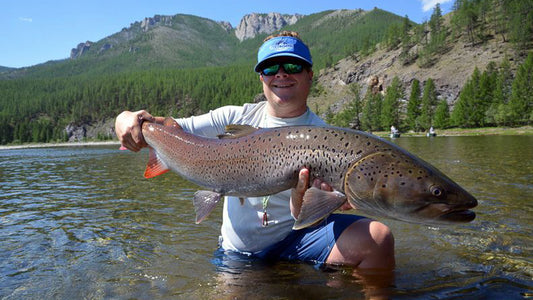
This destination is suited to a wide range of anglers and travelers. It is especially attractive to anglers who would like to target taimen but equally appealing to anglers who enjoy the simple pleasure of productive trout-style fishing for lenok. Taimen anglers who have fairly strong casting skills with 9-weight rods and large flies will be at an advantage, but even novice anglers have a chance at taimen and can experience great lenok fishing daily. The majority of taimen fishing is done from the boat, but the majority of lenok fishing is done while wading. This trip is a truly exotic fishing experience in a beautiful, highly photogenic environment. It is a comfortable, semi-rustic camp that offers a unique and authentic experience that differs in endearing ways from traditional lodges.
Where is the lodge?
The lodge is located on the Ur River several miles above its confluence with the Eg River. The Eg River is at the outlet of Hovskol Lake, in north-central Mongolia. These waters will eventually flow north into Russia’s Lake Baikal.
How do I get there?
Guests traveling from the western US will typically fly to Seoul, Korea, and take a 3.5-hour flight to Ulaanbaatar, Mongolia, where they will overnight. The following morning, they will take a charter flight to a very unimproved airstrip (pasture) very near the camp.
When should I go?
Their season runs from September through mid-October. The first half of the season is dominated by dry fly (meaning larger popper/gurgler style flies) for taimen, and the back half of the season is primarily done with streamers and different types of sink tip lines. The fall colors tend to be great throughout the season, with the birches and broad-leaves changing first and then the larch forests changing later. Anglers should be prepared for cold weather throughout the season, but it gets colder later. Taimen, unlike most other fish, remain very active in cold water and feed aggressively long after the lodge closes.
How will I fish?
When targeting taimen, guests will either fish large topwater flies on floating lines or large streamers on sinking lines. While wade fishing for taimen is possible, much of the fishing is done from boats, as the guides have learned that the fish often attack the flies more willingly when chasing them from shallow water into deeper water. All the guides are masters at setting up “anchor drops” in which they are constantly dropping the boat six to eight feet downstream between casts. Typically, both guests in the boat will fish at the same time, casting to opposite sides of the boat. Covering lots of water is key to taimen fishing as there is estimated to be roughly 30 taimen per mile, and the main river is large and somewhat reminiscent of the Yellowstone.
Flies are cast square to the bank or slightly downstream and then swung down across the current. As the fly is swinging, anglers need to keep the line trapped under their forefinger and, at the same time, impart a jigging or pulsing action to the fly. When a taimen attacks the fly, anglers need to aggressively strip- strike multiple times without lifting the rod tip, much in the same way saltwater anglers do when fishing tarpon or other hard-mouthed species.
Guests who are not skilled at casting big flies with single-hand rods or find it fatiguing can overhead cast 8-weight Spey rods and cover water very effectively, even if they have never previously fished with two-handed rods. For several of the senior guides, but not all, this is their preferred method.
Lenok fishing lends itself to many trout-like fishing methods and techniques. Lenok on the Eg Ur system is relatively large by Mongolian standards, with most running between 16 and 23 inches. These handsome fish are targeted with 5-weight rods, floating lines, and most often while wading. Lenok regularly hold in long soft inside bends and flats where the wading is easy and can also hold in classic choppy riffles where you would expect to find rainbow trout. They are susceptible to naturally drifted dry flies, dry/ hopper dropper set-ups, as well as small woolly buggers or soft hackle fished on the swing. They are not particularly leader-shy, so they will often be fished with 2X tippet, which makes landing a taimen very possible. Lots of taimen, some over 36 inches, have been caught by anglers targeting lenok with small flies, and there have been days when lenok anglers have actually caught more taimen than the taimen anglers! Needless to say, taking a 32-inch taimen on a 5-weight and a small fly in shallow water is a memorable experience!
Is there wade fishing?
Yes. Taimen anglers who like to wade fish can spend up to 40% of their fishing time on foot, depending on the beat they are fishing, but boat fishing is the norm. While most of the lenok fishing is done while wading, anglers can also fish lenok from the boat, and some of the guides might at times row the jet boats in a drift-boat-like fashion for lenok.
Where will I fish?
Guests will typically fish 4-5 different beats during the week. There are four main river beats and one tributary beat that is fished whenever conditions permit. These are massive beats of water that collectively span 70 river miles!
How long does it take to reach the fishing grounds?
Guests will typically be fishing within 10-30 minutes of departing camp, but it can take up to 1.5 hours to motor back to camp from the furthest reaches of the most distant beats. Dressing warmly is mandatory for these long runs.
What type(s) of fish will I catch?
Taimen, lenok, and the occasional grayling.
How many fish will I catch?
There are thought to be only 25-30 taimen per river mile, and they are moody creatures that can be found in many water types. Catching one per day is a nice baseline. Catching three or more in a day is considered very good. Days when none are caught should also be expected on occasion. Lenok fishing can be very productive, and catching 2-3 per hour is common.
Will I see other anglers?
Guests may see some locals fishing from the bank, and occasionally another guide party might be seen at the upper end of the most distant upstream beat.
What are the guides like?
The guides are primarily Mongolian and all are serious professionals skilled in fly tying, casting, hunting taimen and jetboating. All speak excellent English, and many have had the good fortune to spend time and train in the States with top guides from Alaska and Montana. There is typically at least one American guide in camp as well. Most of the guides have spent many seasons at the lodge, with several having spent more than 20 seasons fishing the Eg and Ur rivers. They are great guides by any standard.
What are the physical demands?
They are very minimal. The wading is rather easy, and guests who prefer not to wade can be accommodated. The biggest demand is lots of blind casting, semi-heavy tackle and large flies. Guests should also have adequate balance to cast from a standing position from the jetboats.
Are there any special skills required?
For anglers who would like to focus on taimen fishing with single-hand rods (which many of the guides prefer for hooking fish with strip-sets), a good double haul is important. Saltwater-style strip-setting is another important skill. Lenok fishing does not require any special skills.
Does the lodge provide equipment?
Yes, as a Sage Experiences Outfitter, the lodge will have state-of-the-art Sage rods and reels as well as RIO lines for guests to use free of charge. They will also provide the needed leaders and flies.
What is your favorite setup for the trip?
Taimen: A 9 ft 9-weight rod with a floating line and a 400-500 grain integrated 24 sinking line. If you would like to bring a Spey rod, we recommend a 13-14 ft 8-weight with a Skagit head, a floating tip and 12.5-foot tips in T8, T11, T14 and T17.
Trout: a 9-foot 5-weight with a floating line is all that is needed. Guests who like Spey fishing could also bring a 12 ft 4 or 5-weight trout Spey with a Skagit head and versi tips.
What are the top flies?
The guides will strongly tend towards using their own hand-tied taimen flies. Their favorite surface fly is Ramsay’s Cyclops. Their wet flies tend to be very large and similar to musky flies. Most are tied on 4/0 and 6/0 hooks. Feel free to bring your favorite trout flies for lenok fishing and black woolly buggers in #6 with weighted heads work very well, as well as a wide variety of high-floating foam flies.
What are the options if water conditions become challenging?
Blowouts are not common, and there are no backup fishing options when they occur.
What is a typical day like?
6:00 AM: Generator turns on
6:15 AM: Wood stoves are lit in gers by staff
6:30 AM: Coffee is on in main lodge
8:00 AM: Breakfast
9:00 AM: Depart for fishing
1:00 PM: Lunch served streamside
6:00 PM: Return to camp
7:30 PM: Dinner
11:00 PM: Generator turns off
What is the general vibe, atmosphere and style of the lodge?
The camp/lodge is casual, welcoming and very appealing to guests who enjoy semi-rustic experiences. All the guides dine with the guests, making it feel like a big family.
Is there an on-site owner, manager or other point-person at the lodge?
Yes. Big Gana is the manager and head guide. He is thoughtful and deliberate and takes requests and feedback seriously. He has been associated with the camp for more than 20 years.
Where do we eat, and what are the meals like?
Meals are served in the main lodge. They are hearty, thoughtfully prepared, varied and very good by Mongolian standards. Most dietary restrictions can be accommodated with advance notice.
What is the alcohol policy?
The camp provides beer and wine. Guests are free to bring their own hard alcohol.
Where do we stay, and what are the accommodations like?
The Eg Ur Taimen Camp is nestled on a handsome flat overlooking the Ur River several miles upstream of the confluence of the Eg River. There is a comfortable main lodge building with a spacious dining room, a sitting area and a large adjoining kitchen where meals are prepared. Guests stay in four traditional double occupancy gers, which are insulated canvas-walled yurt-like structures used by the nomadic Mongolians. They have hard floors, electric lights, a table and chairs and wood-burning stoves that are lit each morning by a staff member while guests sleep, and again before guests return to camp each night. The beds have provided heavy cotton sleeping bags with liners and pillows. In back of the yurts, there is a bathroom building with three flush toilets and an additional structure with two showers and a sauna.
Is there internet and/or cell service?
The lodge has Starlink, which works well around the main lodge. There is no cell service.
Are there other activities?
Yes, but they are limited. Guests can visit a nearby Buddhist monastery, hike some attractive back roads, and adventurous folks can climb a steep, scenic mountain behind camp to get great views of the camp and the surrounding valley.
Are there any other expenses?
Gratuities and small gift items are not included.
Do I need a visa?
No.
Are there any health concerns, dangers or annoyances?
We recommend that guests always consult with the U.S. Department of State and the Center for Disease Control websites for general travel information and guidelines.