








Freshwater Predators

RIO's Musky Outbound Lines with Ambassador Rick Kustich

Rick Kustich August 25, 2026

RIO Ambassador Rick Kustich is a fly-fishing writer, instructor, guide, and travel host who began fly-fishing more than 50 years ago on the lakes and streams of upstate New York. The musky bug bit early while growing up on the banks of the Niagara River and its renowned native musky population. Fly fishing is the only method he’s used to pursue musky for nearly 40 years, turning into an obsession to learn, improve and allow fly fishing to be as effective as using gear.

Last year, we put some early prototypes of the new RIO Elite Musky Outbound line into Rick's hands for evaluation. Read below to get into the mind of a musky fly angler, the considerations that need to go into a high-performance, musky-specific fly line, and Rick's rundown on the new RIO Musky Outbound lineup.

Find out more about Rick on Instagram: @rickkustich.

Over the years I learned to make the best of the available fly lines on the market for musky fishing even though few had been designed for this particular purpose. While some sink-tip shooting heads performed well on single-handed rods, most lacked the punch to consistently turn over big wind-resistant flies.

After moving exclusively to two-handed overhead casting for musky, the lack of lines on the market to match this style of fishing was obvious. I struggled with heads designed too long for the desired efficiency. For years I made modifications by cutting back the tip or head to find the right balance. And while some of these tweaked lines loaded the rod well, running line performance was another issue. ‘Manufacturing’ my own lines by cutting and splicing various heads and running lines solved some issues. But it was difficult to find material with enough weight to load my two-handed rods without resulting in a head length that was too long for efficiency. And I grew tired of the line splice clicking through the guides on each retrieve, possibly even a deterrent to a musky grabbing the fly.

My own experience clearly showed the advantages of two-handed casting for covering most musky waters – more consistent hookups and bigger fish. The results didn’t lie. But there was always a nagging feeling of how much more enjoyable this style could be with a high-performance line right out of the box. The new RIO Elite Musky Lines are designed to do just that, plus more.

A high-performance musky fly line goes beyond casting distance and fly turnover. Each time the fly is retrieved, the figure-eight movement is performed with the leader inside the rod tip-top and the fly within two feet of the tip. Once the retrieve is complete, efficiency is essential to working the head of the line past the rod tip quickly using limited energy to load up for the next cast – with as few false casts as possible. A short head and aggressive taper help get the fly back in the water quickly, with no wasted effort.

RIO’s lineup of musky specific options uplevel the efficiency equation with four new lines that cover both single- and two-handed casting styles. I had the pleasure of fishing the prototypes last season and they are by far the best specialty lines for musky I’ve used in nearly 40 years of pursuing the species. The aggressive front taper allows for ease in both casting great distances and consistently turning over the big wind-resistant flies required for musky success.

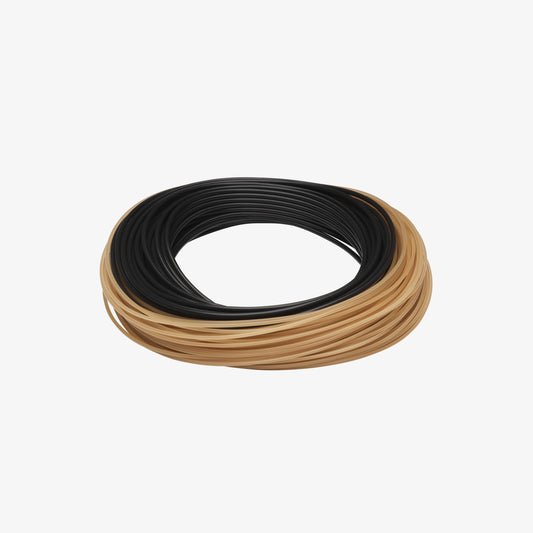
Elite Musky Outbound WF11 I/S5 465gr and WF12 I/S5 510gr feature an aggressive front taper, a 27-foot head length and a fast-sinking tip integrated with an intermediate running line. While these two lines are designed to match up with single-hand casting, the 510 also performs incredibly well with two-hand casting using rods built for lines in the 500gr range.

Elite Musky Outbound 600gr I/S5 is designed as a two-hand overhead casting line that fits within the grain window of most rods on the market designed for this style of casting. It features an aggressive front taper, a 27-foot head length and a fast-sinking tip integrated with an intermediate running line. Elite Musky Outbound Custom T-27 I/S5 completes the lineup with a 30-foot head and total weight of 810gr. It is designed as a custom cut option for two-handed casting, matching rods with the highest grain-weight windows.

Elite Musky Outbound lines cast best with the head and a short amount of running line past the rod tip. In real time casting situations for musky, it isn’t always practical to get the head in the perfect position before making the cast as this can require additional false casts. Because of the aggressive taper the lines possess a very wide launch range where long casts can still be accomplished even when the head isn’t positioned perfectly before making the forward cast.

The mono core running line allows for a strong low diameter that improves casting distance and is easy to handle for the retrieve and strip-set. The running line stays limp in a range of temperature conditions with some minimal stretching. The intermediate running line enhances the depth the sink tip can attain as I found the heads to be effective in water of 20 feet and deeper. However, the lines are versatile. When using a more rapid retrieve rate the tip can cover water that is only a few feet deep.