europe

Alba Game Fishing: Euronymphing in Scotland with the SAGE ESN

Stewart Collingswood February 17, 2026

"I started with the 10ft 2-weight. What struck me first was the sensation of not actually having a rod in your hand. It is hard to describe, but everything becomes an extension of your senses. The 10ft is particularly good for casting smaller nymphs. The sensitivity of the blank is quite incredible. You can feel exactly what is going on at the business end as the nymphs tickle the gravel."

Alba Game Fishing: Euronymphing in Scotland with the SAGE ESN

Before diving into Euronymphing and ESN rods, it’s worth setting the scene. The core of what we do for clients is targeting Atlantic salmon across Scotland’s rivers. As a Sage Experiences Outfitter, our guides are all equipped with the superb R8 Spey rods, in both 13ft, 14ft and 15ft configurations.

That said, last season threw up a bit of a surprise — we hooked an impressive number of salmon while nymphing for grayling and trout. Remarkably, many of those fish were successfully landed on Sage ESN Euronymphing rods.

What makes it even more remarkable is that we weren’t targeting salmon at any point — these fish came to hand on small nymphs and light rods while we were focused on trout and grayling. I could easily write an entire article on why salmon will so confidently take nymphs, but the short version is that it’s likely a conditioned response, rooted in their early years feeding as parr.

Additionally, another contributing factor was that we had an unusually dry summer with low water levels. Last season it pushed fish into deeper, more oxygenated pockets of the river.

Equally, you might ask yourself how our clients managed to land Atlantic salmon on a two or three weight rod.

The answer probably lies in the design and craftsmanship of the SAGE ESN blank. For example, sudden lunges by the fish get soaked up in the flexibility of the rod. Of course, I am not advocating that everyone should start using two or three weight ESN rods for salmon, but we usually have a remarkable 50 percent success rate landing salmon using these light rods.

My Journey with Euronymphing

Firstly, let me rewind and explain my own personal journey and progression with Euronymphing.

Believe it or not, my first experience of this technique was in the 1970s when I was gifted an 11 foot Daiwa sea trout rod by my Uncle Jimmy.

Because this rod was ridiculously long, I developed a technique for nymphing on smaller tributaries of the River Tweed.

The only difference was that this pass me down rod was heavy. My Uncle Jimmy used it for sea trout and salmon on smaller spate rivers. He was a chunky, tattooed army man and I was a skinny 12 year old. However, Uncle Jimmy’s fishing days were behind him. PTSD from the Second World War and 40 cigarettes a day had taken their toll on his health. He became something of a recluse and gave the rod to me one birthday.

I would dangle it awkwardly over a pool and track the nymphs downstream. It caught fish. Little did I know at that time how this technique would develop and how sophisticated the rods would become. However, it did give me a first taste of that concept.

Trial and Error

Fast forward to 2016. I purchased a 10ft 2 weight Orvis Clearwater Nymphing rod.

This was my first dedicated Euronymphing rod. I switched out the fly line, replacing it with 40ft Amnesia mono.

This was a good set up and I caught a lot of fish using it. The Orvis rod is, however, a little tip heavy and after a while I began searching for something better. In fact, I was looking for a rod with less weight, more balance and a better feel.

In 2017 I purchased two Tenkara rods and we had a day with an expert teaching us the nuances of this technique. We still hold them in stock for guests to try, but there has not been much interest and they have not been requested once.

The next rod I tried was the Vision Nymphmaniac. I opted for the 11 foot two weight. This was a big improvement in performance and offered exceptional value. However, after three or four of our rods suffered broken tips, we began to question the resilience of this rod. For the record, the tip on these rods is made of a composite material which breaks cleanly when you snap it. It is definitely easier to break than rolled carbon.

Moving forward, I decided that I was enjoying my Euronymphing journey so much it would be worth investing in a high end rod. So I opted for one of the best.

Upgrading to Sage ESNs

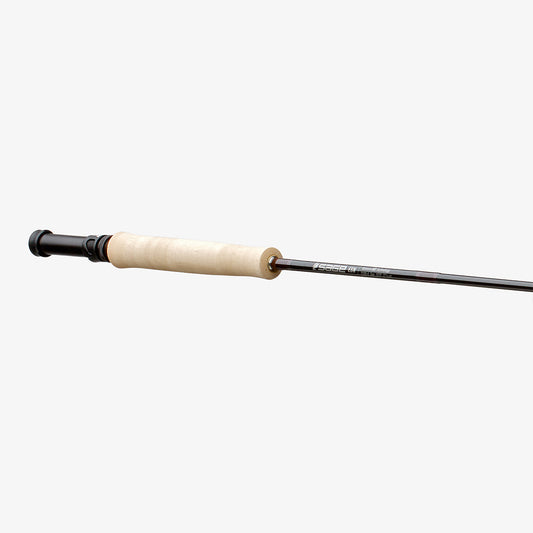
Biting the bullet, I invested in two SAGE ESN rods. As you know, ESN stands for European Style Nymphing, and I opted for the 10 foot two weight and 10 foot 6 inch three weight models.

Everything about these rods spoke quality. The exquisite dark finish, quality cork and iconic look. Made in the USA.

Excitedly, I headed down to the River Tweed to try them both out.

I started with the 10ft 2-weight. What struck me first was the sensation of not actually having a rod in your hand. It is hard to describe, but everything becomes an extension of your senses. The 10ft is particularly good for casting smaller nymphs. The sensitivity of the blank is quite incredible. You can feel exactly what is going on at the business end as the nymphs tickle the gravel.

Furthermore, it is better to use a thinner mono with this rod. For example, 6lb Amnesia is perfect. This is excellent mono from the USA with hardly any memory. It tends to stay straight and does not get twisted. This results in fewer twists around the tip rings. You euro maniacs will know exactly what I mean.

Dart Like Accurate Casting

Another notable feature is the accuracy of casting. This rod has dart like accuracy. Therefore, when you are trying to reach tricky and inaccessible spots like under trees or bushes, this is the tool you want. The tip recovery on this rod is unequalled and this gives it a fast, accurate casting action.

I christened this rod with a 45cm grayling. Without doubt, it was an amazing experience on this rod and it did not lack control for a fish of this size.

The SAGE ESN 10ft 6 inch three weight is different but equally as good. If fishing with 4 to 5mm tungsten beads on nymphs ranging from 0.5 to 1 gram, then the 10ft 6 is the rod of choice. If fishing lighter nymphs, the 10ft is the best rod. After using these rods for several years I would summarise them as follows. The 10ft is ideal for smaller rivers and low water conditions. The 10ft 6 is better for bigger rivers because of its extra reach and power. Do not get me wrong, this rod is still incredibly light. It is an absolute joy to fish with. Indeed, if I were to pick one rod to take on a trip, this would be it.

I have landed so many good fish on this rod, the biggest being a 14lb salmon on the Tweed. I could not take a photo as I had left my phone in the car, but the memory will stay with me forever.

Grayling Fishing with SAGE ESN Rods

Without doubt, the River Tweed is one of Europe’s best grayling rivers. At the time of writing this article, it is the beginning of the winter grayling season here. Although it is quieter at this time of year for guiding, we still get a lot of guests who are grayling enthusiasts looking to fish in the winter. There also seems to be more demand from North American guests to target these fish. They can be caught all year as there is no close season, apart from leaving them alone during spawning in March.

Stewart Collingswood’s Top 12 Euronymphing Tips for Trout and Grayling

1. Tie shorter dropper knots and tidy up the tags. I aim for 2 inches in length on droppers. Do not use tippet rings, a three turn water knot is more effective. If you get snagged using a tippet ring, it more often than not breaks off at the ring, leaving the debris of a whole cast and flies in the river.

2. Keep your casting stroke smooth and progressive. Build momentum smoothly and progressively. This will result in fewer tangles.

3. Use the RIO Two Tone Indicator Tippet. I use the multicoloured indicator and add black stripes using a permanent marker. This helps the indicator to be seen in most light conditions.

4. Secure your nymphs to the cork handle when on the move. It sounds simple but it avoids tangles when walking between pools.

5. In clear river conditions, do not go too colourful or flashy with nymphs. Stick with dull, imitative and lightly dressed patterns. Experiment with sizes.

6. In high water conditions, when the water is coloured, an orange bead is a must.

7. Play fish with side strain and steer grayling into slack water gently.

8. Please leave the dorsal fin alone. Take a photo of the fish in the net and release with minimal handling.

9. In low water, aim for faster, more oxygenated water at the head of pools. You will be surprised where fish can be found.

10. Avoid fishing during the lead up to and during spawning time. We need to protect and nurture future brood stock. Spawning varies from river to river and depends on recent weather. If in doubt, visit the Grayling Society for information.

11. Aim to hover or dance the tail nymph on or near the bottom. Experiment with weights and remember 6X will get nymphs down quicker than 5X, as will casting further upstream, as will narrower profile flies with less bulk.

12. As your nymphs cast and land on the water, observe the number of rings created by each nymph hitting the surface. Two flies will create two rings of disturbance, three will create three. If you do not see two or three rings, you have a tangle. Stop and tidy it up. Continuing to cast will magnify the mess.

Alba Game Fishing - Sage Experiences Outfitter Perfect Setups

Since becoming a Sage Experiences Outfitter, all of our guides carry new stock of the excellent R8 flagship rods and the ESN rods. It has been a significant investment for us and one that has been enjoyed by our guests. Each of our guides carries three Sage Spey rods, three R8 trout rods, including the Classic range, and two ESNs.

I have just returned from an unforgettable visit to the Sage factory in Bainbridge Island. I met the people, the skilled craftsmen and women, like Rose, who has worked there for over 30 years. I witnessed the skill involved in making these rods and it is quite incredible. The quality control throughout the whole handmade craftsmanship process is of the highest level. Everything is meticulous and with an eye to detail. I am not ashamed to say, as a Sage enthusiast, that at times I had goosebumps while meeting the team and watching it all.

Considering the daily workload in Scotland and the fish these rods have dealt with in a season, we have had no breakages and nothing but positive comments from our guides.

In summary, the SAGE ESN Euronymphing rods receive the highest accolade from our team. They are simply the best rods out there for Euronymphing. Considering the work that goes into making them, the quality of materials, the quality control and the 25 year guarantee, it is hard to understand why the rod only retails for £1000. Probably one of the best value rods available.

Alba Game Fishing - Author Stewart Collingswood

Stewart Collingswood is the founder and one of the team of guides at Alba Game Fishing Ltd.. He has guided on Scottish rivers for 22 years and delivers Sage Experiences guided fishing trips for Fly Water Travel guests in Scotland.

EXPLORE