On Location

Gusto Intenso | On Location with Hansi Johnson in Italy

Hansi Johnson October 28, 2026

A family vacation to Italy doesn’t usually come with an added fishing itinerary, but Hansi Johnson found a way to make it happen. Originally born in Italy to an Air Force family, Hansi's connection to his roots has pulled him from his Minnesota homebase many times over the years.

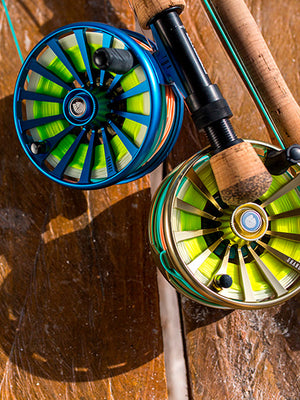
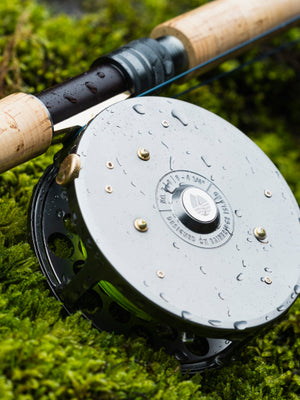
This year, the Engagement Director for the Minnesota Land Trust and Board Member at Sportsmen for the Boundary Waters, packed a few extras for his family trip back to Bel Paese—namely, a couple of Redington rods and reels—to achieve a years-long dream of pinning down a few Italian species.

In between dawn trout sessions in local villages and running boats in the lagoons of Venice for sea bass, Hansi and family got their fill of Italian history, cuisine and culture. Read the full story below and get a new perspective on experiencing Italy—beneath the surface.

This summer, on a classic family vacation in Italy, I set out to find a way beyond the familiar circuit of churches, castles, and art. A veteran of these excursions, I had done my homework: if I packed a rod and found the right water, I might be able to slip a little fishing into the itinerary.

My research turned up a promising surprise: the small town where we were staying, Vittorio Veneto, had a trout river running straight through it. Bingo. All I had to do was pack a rod and some wet-wading gear—and unravel the Italian permit system, but that is another story.

Thus, I had two hours each morning to fish the river Meschio before my family stirred from pasta-infused slumbers.

In Italy, it’s possible to mark time while fishing by listening to the church bells. I did not need a phone or a watch. The Duomo di Serravalle dominates the town, and its deep baritone bells carry across the community with distinct authority. They always seem to ring a minute or two early; once the hour strikes, a host of smaller sanctuaries answers with higher, tinnier bells. That cacophony is impossible to ignore. It tells me to reel up, walk to the pasticceria, and catch a cappuccino and pastry before heading home to my waking family. It is as if God himself is calling me off the river and reminding me to be a responsible father. At the espresso bar, the cameriere eyes my fly rod, wet pants, and muddy boots, then relaxes when I take an outside table overlooking the river. I signal in crude Italian for a cappuccino. Ah, Italy—you do have this shit down.

One sunny morning I found myself fishing through the Old Town, a Medieval village. I started casting at the base of an old building with what appeared to be an aqueduct.

The aqueduct looked old—Roman old. It sat deep at the base of the riverbank, beneath a tapestry of fabricated infrastructure built by generations trying to tame the Fiume Meschio. Its mouth was a gaping half-circle of interlocked stones set perpendicular to the rushing current. By the fifteenth century, the river was prized for its ultracold water, which tempered hot steel used to make the famous “Swords of Serravalle.”

Maybe blacksmiths once plunged glowing blades into that brisk, surging, clear water. The trout holding beneath the Roman culvert did not care about its history; it cared about the perfect ambush spot. The fish coasted in and out of the shadows, its nose barely visible as it subtly fed on unsuspecting prey. I could not judge its size, but it carried the kind of gravity a savvy angler associates with one word: “Grosso.”

There was no easy way to cast to this trout. The water was nearly four feet deep and blasting down a fairly steep gradient. The river was encased between old stone walls that were roughly four to five feet high above the river. I had to hop up on the wall, manage to avoid a chipped and leaning marble statue with a back cast and immediately mend to manage the fast flow. A dry fly would have been best, but with no obvious hatch at the moment, a streamer was my tool of choice.

Such an interesting challenge, to literally fish around a thousand years of history.

The more you fish, the stranger the skills you acquire, and I knew exactly which esoteric cast this situation required. I threw a heavy gold-and-white Sparkle Minnow and deliberately bounced it off the crumbling, vine-covered stone wall—a classic smallmouth move. The fly dropped into the seam between the wall and the pulsing water. One quick, hearty mend sent it plunging through the water column, where it hung broadside to the current just upstream from the hiding place. Then the current caught my line, and the fly accelerated through the shadow, tracing a bright arc across the darkness.

It was immediately clear that the fish that emerged from that ancient hide was far too big for my gear but I had no time to retreat. It ate the fly with a rush, and as it did I recognized the patterns of a huge Marble Trout.

I was in trouble.

My tiny four-weight was already maxed out, my tippet was too fine, and the fish had plenty of obstacles to escape into. I was standing above a canal with no safe way into the river, and the trout was literally bigger than my net. Boat-flipping it over the wall was not an option. It looked more like a decent pike than a trout. The fish ran upstream and I hung on, then it ran way downstream and I hung on some more, running after it along the canal wall. My rod bent double, it looked like a half boiled piece of #8 Spaghetti.

In the chaos, I could hear loud voices as I was charging down the run and realized there was a group of brown-bottle-waving winos on the opposite side of the river. They were cheering for me in colorful Italian as I battled the trout.

Eventually, the beast slowed and buried itself down deep on the river bottom for a minute.

As painful as it was, I knew what I had to do. I reached as low as I could, cut the line, and called the whole adventure a success. There is a first time for everything.

The espresso hit a bit differently that morning!
After a week of bliss in Vittorio Veneto, I left the family and boarded a train for Treviso to meet my Italian friend Boris Salnicoff. For four months, Boris and I had been trading WhatsApp messages about a different kind of Italian fishing: chasing sea bass in the lagoons of Venice.

Honestly, Boris had me at “fishing,” but adding “the lagoons of Venice” had me packing immediately. I stashed my Wrangler 4wt, tossed my Big Game 7wt into the bag, hopped a train south, and lodged myself in a hot, un-air-conditioned VRBO in Treviso. Boris picked me up at 4 a.m. the next morning, and we drove about 30 minutes along gravel backroads to a row of sun-beaten wooden boathouses. The place felt strangely familiar; it could have been one of the backwater sloughs on my home water, the Upper Mississippi River.

But that was where the familiarity ended. As the sun rose, flocks of flamingos crossed the tidal marsh while mullet splashed through the sun-kissed shallows. Far in the distance, I could see the towers of Venice among the lagoon’s barrier islands.

Elia, our third angler for the day, was late because his dad had given him the wrong keys to the boathouse. Tardy fishing partners: a universal theme, no matter where in the world you fish. The next universal theme arrived when the outboard refused to start a few minutes from the launch. Boris and Elia apologized, but they relaxed when I told them I was more than familiar with these problems. Fish long enough and you learn that happens to everyone.

We cast little Gurglers toward the seagrass wherever the tide streamed in. The water was clear, and the bass were extremely picky, but after a while I found the rhythm and we boated several fish. At lunch, we stopped on the island of Torcello and feasted on calamari, polenta, and langoustines at a small seafood stand beside a mussel-encrusted canal. Between mouthfuls of seafood and cold beer, Boris told me Hemingway used to frequent Torcello. Then he casually mentioned that we could walk down to the square and sit in Attila the Hun’s throne. Damn. Like I said, Italy has this shit down.

We fished until the tide switched, then motored through the lagoon past barges and old commercial fishing camps toward the boathouse. After one more cold beer at a local bar, Boris hugged me goodbye at the Treviso train station. I stepped aboard still charged by the day. As I rolled off, my thoughts drifted back to dawn on the Meschio—to swinging streamers for fat trota marmorata, listening for church bells, and tossing back cappuccinos before my family woke. I still had another week in Italy and it was going to be a good one.